Optimizing Large Language Models for Low-resource Quality Estimation
Optimizing Large Language Models for Low-resource Quality Estimation
Abstract
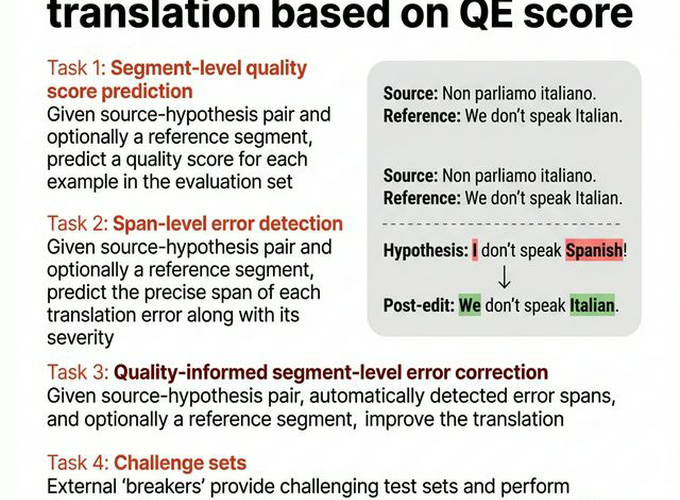
Large Language Models (LLMs) are positioned as generalist models often claiming superlative performance on many Natural Language Processing (NLP) tasks. However, they tend to fail at Quality Estimation (QE) of Machine Translation (MT), particularly for low-resource languages. The talk investigates root causes of this disparity, such as tokenization inconsistencies arising from morphological richness in natural languages. To bridge this gap, the talk introduces strategies to embed annotation guidelines-based reasoning constraints directly in-context. Furthermore, our investigation on optimal cross-lingual alignment shows that intermediate Transformer layers help produce performant adapters. By attaching Low-Rank Adapter (LoRA) based regression heads to intermediate layers, we bypass the generation-specific biases of the final layer, efficiently outperforming standard instruction fine-tuning and SoTA encoders like COMETKiwi. Finally, via results from the WMT Unified Shared subtask on QE-informed Correction, we demonstrate that these precise estimations can guide LLMs to produce reliable corrections. We discuss how these signals help address the “diminishing returns” challenge, enabling models to improve fluent outputs without diverging from human references.