Investigations into Distributional Semantics for Cognate Detection and Phylogenetics
Abstract
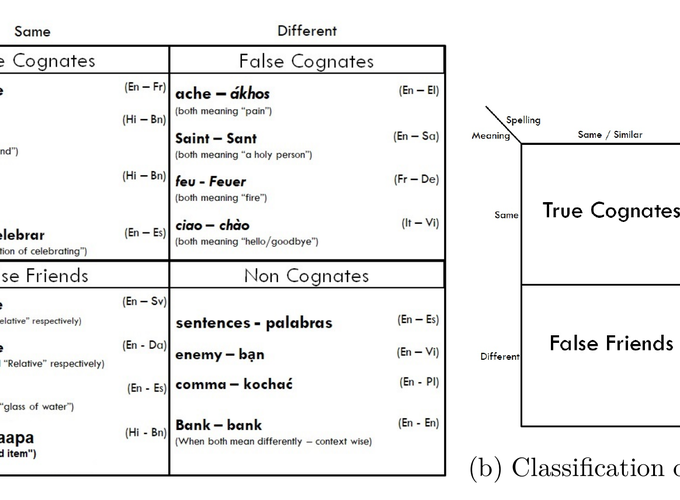
Distributional semantics has become a key component of natural language processing (NLP) tasks as it allows computational models to understand natural languages. The sharing of vocabulary among different languages facilitates language learners to acquire a second language with much more ease, and it enables the computational models to perform cross-lingual learning for various NLP tasks. This thesis describes our work on two problems: cognate detection and false friends’ detection. Our investigations in distributional semantics for both problems are based on the linguistic phenomena of shared vocabulary in related languages. Cognate words are variants of the same lexical form across different languages. Similarly, false friends are word pairs from two different languages which pose a challenge to cross-lingual NLP tasks since they share similar spelling but differ in meaning. Existing approaches rely heavily on phonetic and orthographic information but neglect cross-lingual semantic information. Our investigations use cross-lingual features to help detect cognates and false friends across languages.